Capability
Salesforce POS integration: run the whole transaction natively
Eposly is native Salesforce POS integration: configure, price, take payment, and create the order in one Salesforce flow. No middleware, no external POS, no reconciliation.
The challenge
The cost of executing transactions outside Salesforce
Most Salesforce orgs run their POS outside Salesforce. Traditional architectures push transactions through middleware into external POS systems, then attempt to sync data back into Salesforce. The result is fragmented data, delayed synchronization, complex integrations, and limited operational visibility. That gap also extends to the payments hardware itself: terminals and related transaction systems sit outside Salesforce, adding another layer of operational complexity.
-
Fragmented data
Transaction data lives in a separate system. Customer records in Salesforce are incomplete.
Fragmented data
Transaction data lives in a separate system. Customer records in Salesforce are incomplete.
-
Complex integrations
Middleware, APIs, and sync jobs create maintenance overhead and failure points.
Complex integrations
Middleware, APIs, and sync jobs create maintenance overhead and failure points.
-
Delayed visibility
Teams can't see transaction outcomes in real time. Reporting depends on batch syncs.
Delayed visibility
Teams can't see transaction outcomes in real time. Reporting depends on batch syncs.
See a transaction in action
Watch how orders and payments are completed in a single Salesforce flow in the video below, or skip ahead and try the interactive demo yourself.
The Eposly approach
A Salesforce POS that runs where the data lives
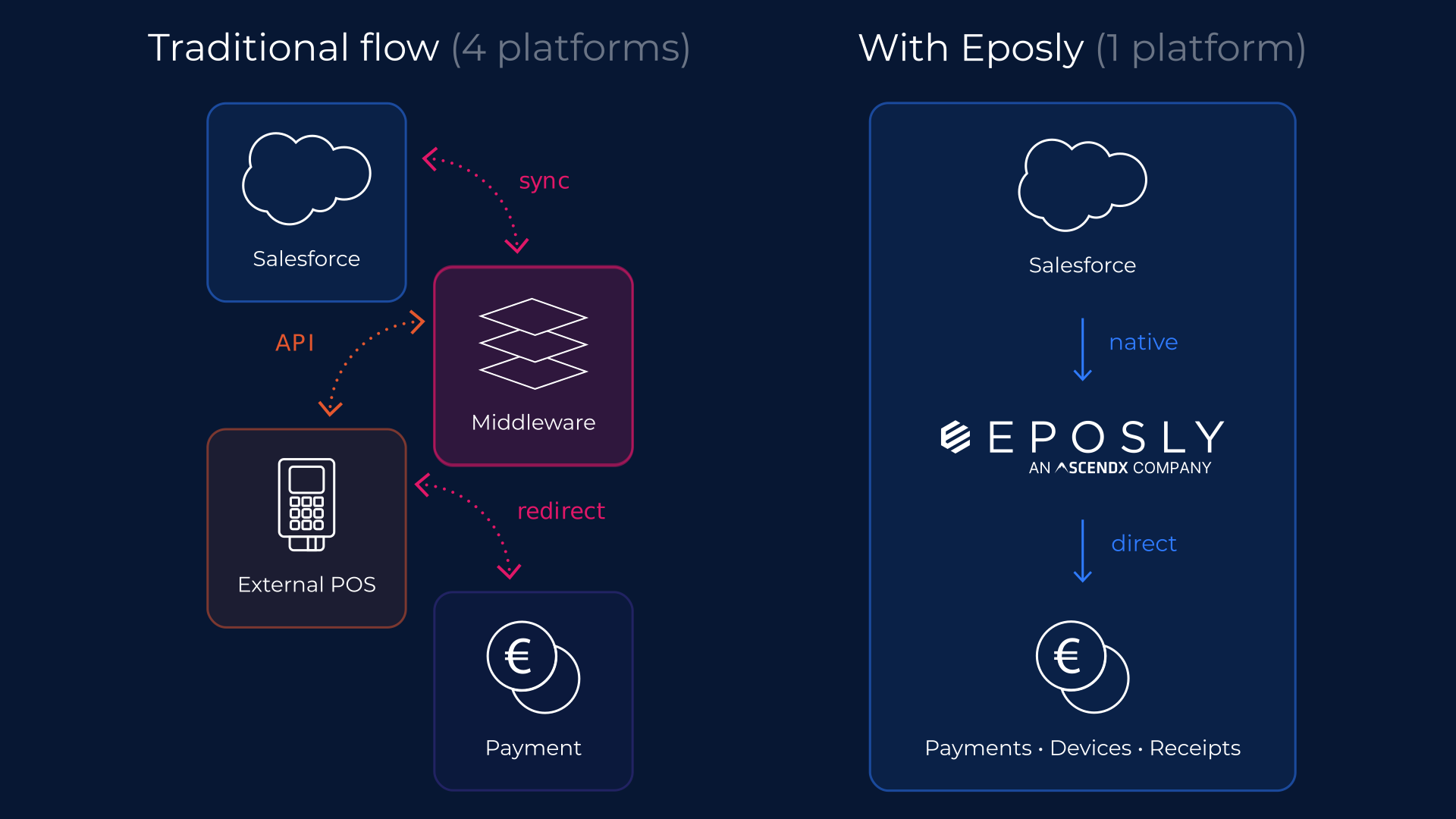
Eposly is a Salesforce POS that runs directly on Salesforce objects, automation, and the same data model. No middleware. No sync. No reconciliation.
Data architecture
Native Salesforce objects, native automation
Eposly uses standard and custom Salesforce objects for all transaction data. That means native reporting and automation, with no middleware layer.
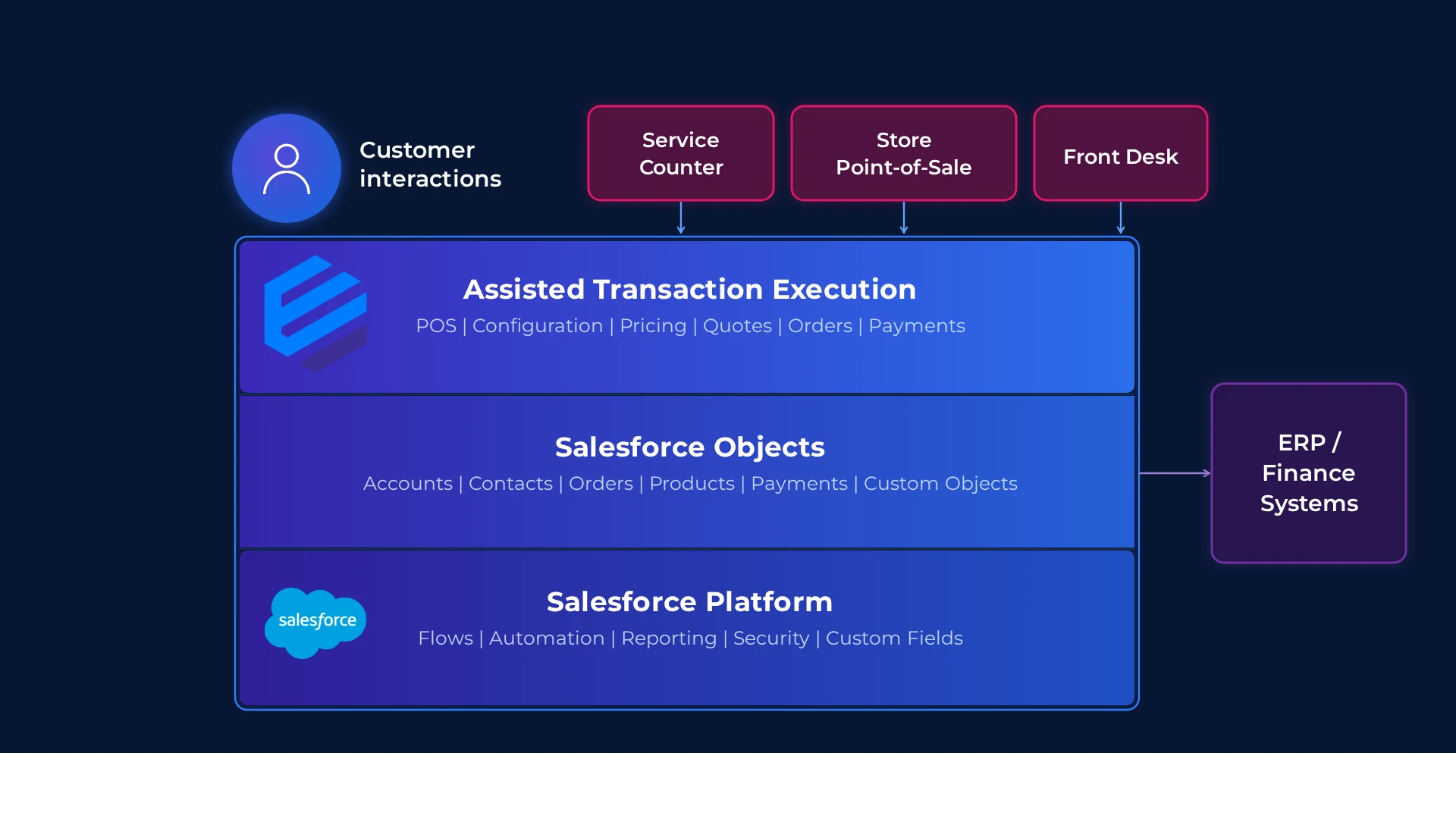
Salesforce-native architecture: same data model, objects, and automation. Extends Salesforce without breaking it as the system of record.
Features
Core transaction execution features

Salesforce-native transaction execution
Complete configuration, pricing, payment, and order creation in one simplified Salesforce flow.
Unified customer and transaction records
Capture every transaction directly on the Salesforce customer record.
Real-time order creation
Create orders instantly during the customer interaction without external checkout systems.

Transaction-driven customer intelligence
Each transaction enriches Salesforce with pricing, configuration, and purchase data.
Salesforce-native data model
Leverage Salesforce objects for reporting, automation, and customization.
Salesforce automation compatibility
Trigger flows, automations, and integrations directly from transaction data.
“The system is well-architected to serve a variety of customer use cases, from out-of-the-box point of sale to custom implementations with different integration points. Highly recommended.”
— Will Nourse
In practice
Use cases by industry

How a retail jeweller executes configured transactions
A sales associate at a luxury jewellery retailer helps a customer configure a custom ring — selecting stone type, setting, and engraving. Pricing updates in real time as options are chosen. The associate applies a returning-customer discount, processes payment via card terminal, and the complete order, configuration details, and payment confirmation are recorded on the customer's Salesforce record. When the customer returns months later, the next associate has full visibility into what was purchased, how it was configured, and what pricing applied.
Why Salesforce-native
Why a Salesforce-native POS wins
Eposly is the only POS that runs 100% inside Salesforce — not connected to it via API or middleware. When a transaction executes natively, every Salesforce Flow fires immediately, every customer record updates in real time, and every automation runs without a webhook delay or sync job. No middleware. No reconciliation. No second system of record. The result is a Salesforce environment where the transaction itself happens inside the platform, not outside it.
Unified data model
Transaction, order, and customer data share the same Salesforce schema.
No integration layer
No middleware, APIs, or sync jobs to build or maintain.
No reconciliation required
Transactions are created inside Salesforce, not synced to it. There is no external ledger to reconcile — orders and payments are linked at the moment of execution.
Native automation
Transactions trigger Salesforce Flows, Process Builder, and approval workflows.
Real-time visibility
All transaction data immediately available in Salesforce reports and dashboards.
Simple and built to adapt
Runs natively on Salesforce objects, fields, and flows. Flexible configurations using standard Salesforce functionalities, not custom development or hard coded systems.
Faster operational changes
No rigid external POS logic to work around. Add a field, adjust a flow, or change a process using familiar Salesforce tools.
Related capabilities
Explore other capabilities
FAQ
Frequently asked questions
Yes. Eposly is a Salesforce-native POS, built as a transaction execution layer that runs directly on the Salesforce platform.
Pricing, configuration, payment, order creation, and receipts all happen inside Salesforce, on the customer record, with no middleware or external checkout system.
It is designed for assisted, customer-linked transactions in service, B2B, clinical, and high-touch retail environments.
A Salesforce-native point-of-sale (POS) system is a checkout and transaction layer built directly on the Salesforce platform, using its objects, automation, and security model.
Unlike a traditional POS connected through middleware, a Salesforce-native POS executes pricing, payment, order creation, and receipts inside Salesforce itself, on the customer record.
Eposly is a Salesforce-native POS designed for assisted, customer-linked transactions across service, B2B, clinical, and high-touch retail.
A traditional point-of-sale system is an external application connected to Salesforce through middleware, APIs, or batch syncs. Customer, order, and payment data live in two systems and must be reconciled.
A Salesforce POS like Eposly executes the transaction inside Salesforce itself. The customer record, the pricing, the payment, and the order share one data model and one source of truth.
The result: no integration tax, real-time visibility, and customer history that stays complete across every channel and team.
Eposly executes transactions inside Salesforce at the moment a customer commits.
Revenue Cloud is built for managing long revenue lifecycles such as subscriptions, contracts, and renewals.
Eposly fits where those models do not apply, when you need to complete a transaction (pricing, payment, order, receipt) directly inside Salesforce without introducing a full revenue platform.
Yes, Eposly is a point-of-sale system, but a Salesforce-native one built for assisted transactions rather than high-volume retail checkout.
It is not designed to replace traditional retail POS systems used in standardized store environments with anonymous, self-scan, or queue-driven checkout.
Eposly fits where:
- the customer is identified in Salesforce before the transaction begins, with their account, history, and entitlements already in view
- the interaction is guided by an agent, advisor, or representative following a defined process, not a self-service checkout
- every step of the transaction (quote, payment, order, receipt) must be captured against the Salesforce record so the customer history stays complete and auditable
This includes service environments, B2B sales, clinics, and complex in-person or remote transactions.
Payment apps help you collect money. Eposly enables you to execute the full transaction inside Salesforce.
That includes:
- pricing and configuration
- payment execution
- order creation
- receipts and approvals
- capturing the full context of what happened
All in one flow, tied directly to the customer record.
Salesforce can support parts of this, typically through integrations or external tools.
Real-world transaction steps such as:
- payment terminals
- receipt printing
- cash handling
- device interactions
are not native capabilities of Core Salesforce and often require external systems or custom setups. Eposly provides these capabilities natively within Salesforce, as part of the transaction flow.
Eposly is designed for assisted transaction environments that may include:
- payment terminals (chip and PIN, contactless)
- receipt printing
- barcode scanning
- cash drawer workflows
These are handled as part of the Salesforce transaction process, not as separate systems. Exact compatibility depends on your payment setup, region, and workflow requirements, and is validated during implementation.
No. Eposly runs natively on the Salesforce platform.
There is no middleware, external transaction engine, or data sync layer. Transactions are created and processed directly within Salesforce using its native data model and automation.
Yes. Eposly supports:
- in-person transactions via payment terminals
- remote payments via links or virtual flows
All transactions are tied to the same Salesforce record, maintaining full customer context.
Yes. Eposly operates within Salesforce and aligns with its data model, security, and automation framework. It is designed to extend your existing setup, not replace it.
Because Eposly runs on Core Salesforce, it works across environments such as Health Cloud and other industry clouds. This is particularly valuable where transactions need to stay connected to customer or patient records across different interaction channels.
Yes. Eposly leverages Salesforce's infrastructure for scalability and reliability.
Transaction throughput aligns with Salesforce platform capabilities and is designed for enterprise use.
Because the transaction is the moment that defines the customer relationship.
When payment, receipt, and order execution happen outside Salesforce, that moment becomes fragmented.
Eposly keeps the entire transaction inside Salesforce, so the system reflects exactly what happened, as it happened.
With Eposly, the order and the payment are created together in one native Salesforce flow. Rather than syncing an external order or payment record back into Salesforce, Eposly configures the order, applies pricing, takes payment, and writes it all to the customer record at the moment of sale, with no reconciliation.
Yes. Eposly executes the full order-to-payment sequence inside Salesforce: configure, price, take payment, create the order, and update the record, in a single native flow with no middleware and no external order management system to reconcile.
Ready to run the whole sales process inside Salesforce?
See how this would work in your Salesforce setup.