Retail
Furniture POS software that runs inside Salesforce
Run every furniture sale, from showroom quote and configured order to deposit, delivery, and final payment, inside Salesforce, so the customer record is always complete. Eposly point-of-sale (POS) is built for furniture and home-furnishings retailers that run on Salesforce.
What is a furniture POS system, and can it run on Salesforce?
A furniture point-of-sale (POS) system takes payment and records the sale for a furniture retailer, usually across a long journey of quote, deposit, order, and delivery. A Salesforce-native one executes the transaction inside Salesforce, on the customer record, so the configuration, pricing, deposit, and delivery status all stay on the record instead of a separate POS database.
In short, Eposly is furniture POS software for Salesforce, built for retailers that run their customer relationships on Salesforce and want the transaction to execute there too.
How Eposly fits furniture retailers
A furniture sale is a consultation, not a simple checkout. It runs across weeks: quote, deposit, configured order, manufacturing, delivery, final payment. The order stays open the whole time, and every stage carries context: what was configured, the price agreed, the deposit taken, the delivery promised.
When the transaction runs in a separate POS, only partial data comes back and teams rebuild the detail later. Eposly executes transaction execution inside Salesforce, on the customer record, so each stage is captured as it happens. It complements your ERP, inventory, and warehouse systems rather than replacing them.
Furniture relationships last years: repeat buyers, interior designers, developers. Keep every purchase, delivery, and open opportunity on one Salesforce customer record, and associates get context no standalone POS can match.
Why furniture retailers outgrow traditional POS
Traditional retail POS systems are built for fast checkout. Furniture retailers operate differently.
That is why Salesforce-based furniture retailers want the transaction to execute where the customer relationship already lives.
Every stage of the furniture sale, on one record
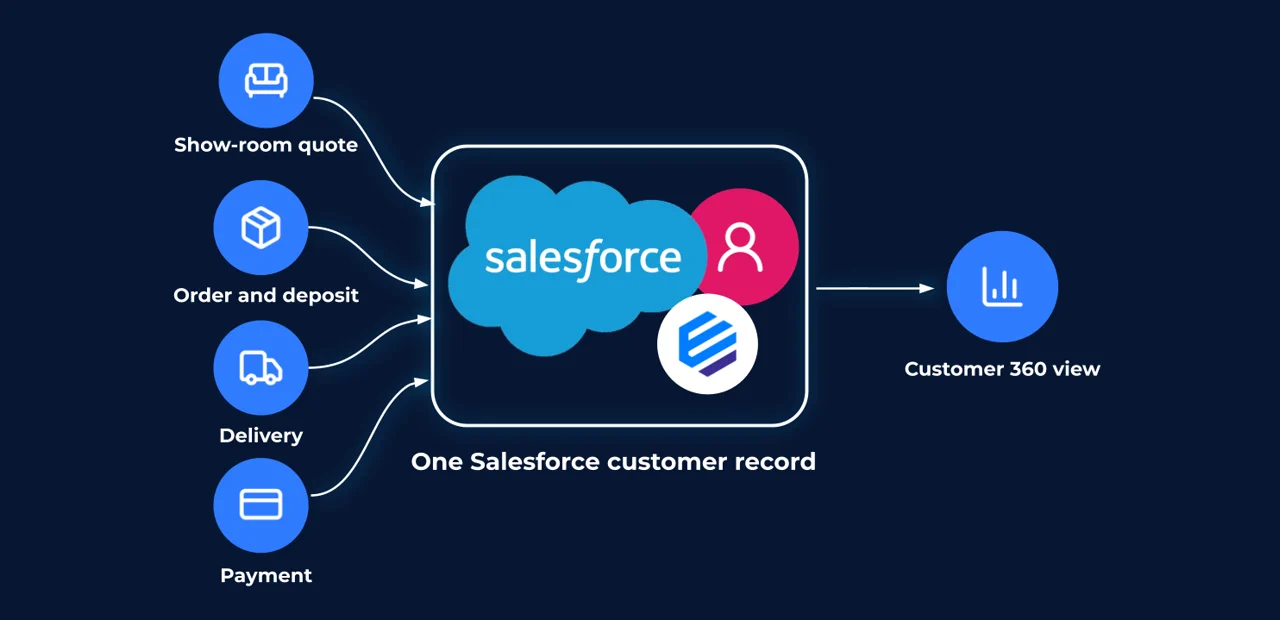
Furniture sales don't happen in a single checkout; they evolve over time. This shows how Eposly keeps every commercial event on one Salesforce customer record.
What you get and how Eposly works on Salesforce
-
Deposits and partial payments on an open order
Take a deposit or a partial payment against an open furniture order, and collect the balance when the piece is ready, all on the same customer record.
-
Configurable products, priced at the point of sale
Configure the piece (fabric, dimensions, finish, options) and apply the resulting price at the point of sale, with the configuration and price recorded on the customer and order record.
-
Quotes that become orders without re-keying
Build a showroom quote and convert it to an order without re-entering anything, so the negotiated terms carry straight through to the transaction.
-
Assisted showroom selling with customer context
Sell with the full customer history and preferences on hand during a long consultative sale, and record the result against the customer in Salesforce.
-
Delivery and follow-up from the same record
Coordinate delivery and follow-up from the same customer record the sale was executed on, so nothing is tracked in a separate system.
-
Commission attribution on the transaction
Attribute the sale to the associate who made it as part of the transaction record, so commission is tied to what actually happened.
See it in action
Configuration, pricing, and mobile POS for furniture retail
The same demos shown across specialty retail apply directly to furniture: configure the piece, price it at the counter, and take payment on iPad inside Salesforce.
Mobile POS for the showroom floor
Sell from anywhere in the showroom on iPad, with the customer record and configured order in view.
Salesforce-native by design
A separate POS completes the sale in its own system and syncs a summary back to Salesforce later, so the customer record is only ever a partial, delayed copy. Eposly inverts that: every element of the transaction is executed inside Salesforce, on the customer record, as it happens. No parallel POS system, no reconciliation back from a separate database.
-
Transaction records are created in Salesforce
Orders and customer-linked transaction records are created in the same Salesforce environment used for the wider workflow.
-
The existing customer record stays central
Eposly uses the existing Salesforce customer record rather than creating a separate POS customer database.
-
Payment credentials stay with the payment provider
The connected PCI-compliant gateway handles and tokenizes card details, while Salesforce stores the operational transaction record.
Used across specialty retail on Salesforce
QLF Brands, a Dutch homewares and lighting retailer, runs Eposly across showrooms, warehouse, and e-commerce on Salesforce Sales and Service Cloud. Although QLF operates across homewares and lighting rather than furniture specifically, its showroom-led specialty-retail model runs on the same Salesforce-native transaction approach. Eposly is rated 5.0 from 26 reviews on the Salesforce AppExchange.

Questions buyers ask
Ready to run the furniture sale inside Salesforce?
Eposly fits furniture and home-furnishings retailers that run on Salesforce, sell through assisted showroom consultations, take deposits on configured orders, and want every stage of a long sale on the customer record instead of a separate POS. It is not built for high-volume anonymous checkout, and it does not replace your warehouse, inventory, or ERP system.