Services
Winery POS software that keeps tasting room, wine club, and DTC on one Salesforce record
Run tasting-room sales, wine club, and case and direct-to-consumer (DTC) orders inside Salesforce, so every purchase and club renewal stays on the customer record. Eposly is built for wineries that run on Salesforce.
What is a winery POS system, and can it run on Salesforce?
A winery POS system takes payment across the tasting room, the wine club, and direct-to-consumer orders, and records each sale against the customer. A Salesforce-native one executes the transaction inside Salesforce, on the customer record, so tasting-room sales, club renewals, and case orders all stay on one record instead of a separate POS database. In short, Eposly is winery POS software for Salesforce, built for wineries that run their customer relationships on Salesforce and want the transaction to execute there too.
How Eposly POS fits wineries
A winery earns from the same customer in several ways: a tasting-room visit, a wine club that renews over time, and case or DTC orders in between. The revenue isn't one purchase; it's turning visitors into repeat buyers and club members, and that relationship usually already lives in Salesforce.
When the tasting room and club run on a separate POS, only partial data comes back, and the club member, the tasting-room buyer, and the DTC customer end up as three disconnected records.
Eposly POS executes the transaction inside Salesforce, on the customer record, so tasting-room sales, scheduled club renewals, and case and DTC orders all land on one record as they happen. It complements your production, inventory, and shipping-compliance systems, all in Salesforce.
Why wineries outgrow a standard retail POS
Standard retail POS is built for fast, anonymous checkout. Wineries sell differently.
That is why Salesforce-based wineries want the transaction to execute where the customer relationship already lives.
Tasting room, wine club, and DTC on one record
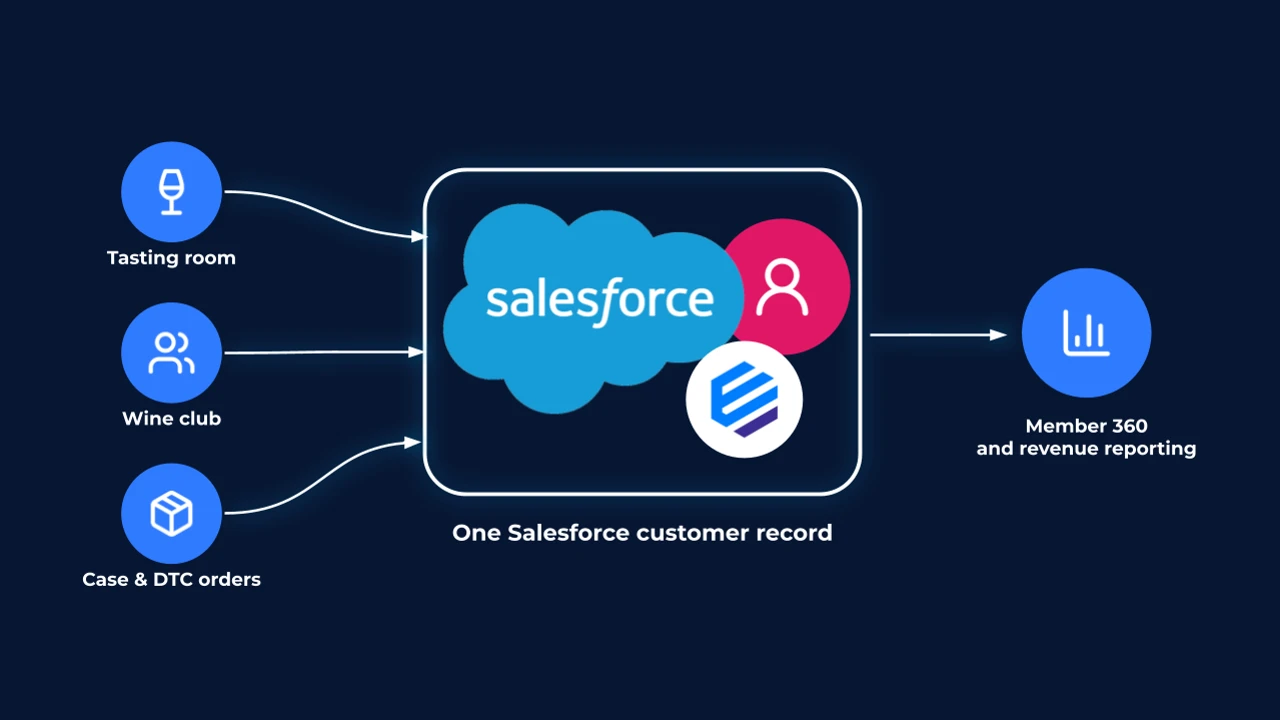
A winery earns from the same customer across the tasting room, the club, and DTC. This shows how Eposly keeps every one of those on a single Salesforce customer record.
What you get and how Eposly works on Salesforce
-
Tasting room POS on the customer record
Every tasting-room sale completes in Salesforce, on the guest's customer record, so the visit, the purchase, and the payment stay together.
-
Wine club, collected on a schedule
Run [wine club renewals as scheduled payment collection](/product/capabilities/payments) on the member record. This is payment collection against the customer's Salesforce record, not subscription billing or revenue recognition.
-
Case and direct-to-consumer orders
Take case orders, reserved releases, and direct-to-consumer purchases on the same customer record the tasting-room and club sales live on.
-
Assisted selling with member context
[Sell with the guest's club status](/product/capabilities/assisted-sales), preferences, and purchase history on hand, and record the result against the customer in Salesforce.
-
Deposits and partial payments
Take a deposit or partial payment on a reserved release or club shipment, and collect the balance later, all on the customer record.
-
Complete customer history
Every sale enriches one customer record, so club, tasting-room, and DTC purchases and member history sit in one place, turning first-time visitors into repeat buyers.
Salesforce-native by design
Eposly is built to execute the winery transaction inside Salesforce, on the customer record, rather than in a parallel POS database.
-
Transaction records are created in Salesforce
Tasting-room, club, and DTC transactions are created in the same Salesforce environment used for the wider workflow.
-
The existing customer record stays central
Eposly uses the existing Salesforce customer record rather than creating a separate POS customer database.
-
Payment credentials stay with the payment provider
The connected PCI-compliant gateway handles and tokenizes card details, while Salesforce stores the operational transaction record.
Customer proof
One payment experience, from vineyard to tasting room
Pearl Morissette, a boutique Ontario winery, uses Salesforce as its customer platform and Eposly for transaction execution, so sommeliers take payments in the tasting room, in the vineyard, and at off-site events, with every sale recorded on the Salesforce customer record. It gives them one view of every customer, every bottle, and every sale.

Questions buyers ask
Explore capabilities and use cases
Ready to run the winery inside Salesforce?
Eposly fits wineries that run on Salesforce, sell through the tasting room, run a wine club, and take case or DTC orders, and want every sale on one customer record instead of a separate POS. It is not built for anonymous high-volume checkout, and it does not replace your production, inventory, or shipping-compliance systems.